






 23 March 2026
How Core Web Vitals Impact Search Rankings: Complete Guide to SEO Performance
Introduction
Website performance is now one of the most critical parts of SEO. Search engines don't just look at keywords and backlinks to judge websites anymore. Today, they pay a lot more attention to how users really utilise your website. Think back to the last time you went to a slow website. The page kept loading, the pictures came up late, and the layout kept changing while you were reading. In those kinds of situations, most people don't wait.
Google added Core Web Vitals to make the user experience better and get a better idea of how well a website is doing. These measurements look at how real users engage with a page and how good the experience is, not just how well it works.
What are the most important web vitals?
Google came up with Core Web Vitals, a set of website performance indicators that measure how users actually use a webpage.
These metrics look at how real people use your website instead of just looking at technical data. They check how fast the page loads, how responsive it is when people use it, and whether the layout stays the same while it loads.
Core Web Vitals answer three crucial issues in simple terms:
- Does the page load quickly?
- Does the website respond rapidly when people do things?
- Does the layout stay the same when it loads?
These measurements are now part of Google's page experience signals, which affect how pages rank in search results. This is important for SEO experts and website owners.
When a website gets good Core Web Vitals scores, it usually suggests that users may explore it without getting frustrated. Search engines reward better website user experiences with higher ranks.
The Three Most Important Core Web Vitals Metrics
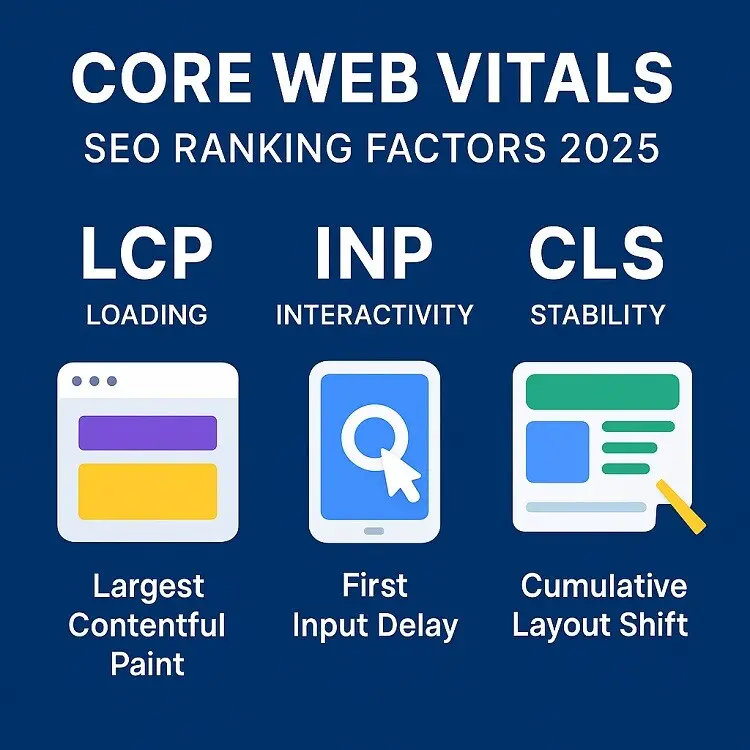
Loading Performance: Largest Contentful Paint (LCP)
Largest Contentful Paint tells you how long it takes for the biggest piece of content on a page to load completely.
This area of the site is usually the most important visual part, like:
- A picture of a hero
- A flag that stands out
- The primary headline
- A big picture that stands out
Users can start interacting with the material right away when this element loads rapidly.
Google says that the following levels of performance are good:
- Good: Less than 2.5 seconds
- Needs work: 2.5 to 4 seconds
- Bad: More than 4 seconds
Large images, sluggish servers, or website coding that isn't optimised are the most common reasons for slow LCP.
Interaction to Next Paint (INP) – How quickly it responds
Interaction to Next Paint tells you how quickly a website reacts when a user interacts with it.
Some examples of interactions are:
- Pressing a button
- Opening a menu for navigation
- Filling out a contact form
Users think a website is fast and seamless when it answers right away. If a website drags its feet, visitors could easily assume something's broken or just plain sluggish.
Several culprits often contribute to this sluggishness:
- Overly large JavaScript files
- An excess of third-party scripts
- Overly complex page elements, which bog down processing
By optimising INP, you ensure that users can interact with your site without any frustrating pauses.
Cumulative Layout Shift (CLS) — Stability of the Visuals
Cumulative Layout Shift tells you how much the layout of a page changes without warning while it is loading.
For instance:
- When an image loads, the text suddenly goes down
- When an ad comes up, a button moves
- Scrolling can cause sections of a webpage to suddenly shift
These layout shifts can be a real annoyance for users, throwing a wrench into their reading and browsing experience.
Google's Core Web Vitals guidelines state that a CLS score below 0.1 is deemed acceptable.
- Scores in the range of 0.1 to 0.25 require some work
- Scores above 0.25 are deemed poor
A consistent layout makes things easier to use and builds trust with the user.
Why Core Web Vitals Matter for SEO
Core Web Vitals are crucial for technical SEO, and they also play a significant role in improving website performance.
Search engines aim to present results that offer users the most satisfying experience possible. When two pages have the same quality of information, the one that performs better usually ranks higher.
How Page Speed Affects Rankings
For a long time, page speed has been a consideration in rankings. Core Web Vitals take this idea a step further by looking at how people feel about page performance.
A website that zips along is usually associated with:
- Greater user engagement
- More pageviews
- Better conversion rates
These indicators tell search engines that visitors find the site valuable.
Effect on User Engagement
People generally leave slow websites rapidly. Research shows that even a short delay in loading a page might make users less interested.
Faster websites assist boost:
- How long people spend on the website
- Interacting with content
- Rates of conversion
This is why customer pleasure and SEO success are intimately linked to how well a website works.
How Core Web Vitals Affect Search Engine Rankings
Website owners can better prioritize performance upgrades if they understand how the key web vitals affect search rankings.
Direct Ranking Factor
Google has said that Core Web Vitals are a factor of how it ranks pages. Content quality is still the most significant aspect in rankings, however performance measurements can change rankings when several pages give the same information.
What happens to crawlability and indexing
Website speed also has an effect on how quickly search engines crawl your content.
If your site has:
- Slow response times from the server
- Big media files
- Heavy scripting
Search engines may not be able to crawl as many pages as they could with the crawl budget they have.
How it relates to user satisfaction signals
User behavior is a big part of SEO.
If your website doesn't work well, it can cause:
- A lot of people leave the site quickly
- Short session times
- Low involvement
These signals tell search engines that users are not happy, which might hurt rankings.
Tools to Test the Performance of Core Web Vitals
To keep your Core Web Vitals ratings high, you need to keep an eye on how well your website works.
Some tools that are popular are:
- Google's Search Console
- PageSpeed Insights
- Lighthouse
- GTmetrix
- WebPageTest
These tools help you find technical problems that are slowing down your website.
Problems That Often Affect Core Web Vitals
Core Web Vitals scores can go down because of a number of technological issues.
Some of the most typical problems are:
- Slow response times from the server
- Big photos that aren't compressed
- JavaScript files that are big
- Changes in layout caused by adverts or dynamic content
Fixing these problems can make the page load much faster and make the user experience much better.
How to Improve Core Web Vitals in Steps
Speed up the loading time of your website
The first step to improving Core Web Vitals is to make the loading time faster.
Some important changes are:
- Putting images together
- Using new formats like WebP
- Picking a trustworthy host
- Minifying JavaScript and CSS
These improvements make the page smaller and load faster.
Make it more interactive and responsive
A website that works well keeps people interested.
Some good ways to do things are:
- Cutting down on the time it takes for JavaScript to run
- Loading scripts at different times
- Getting rid of plugins that aren't needed
- Using frameworks that have been optimised
These changes make it possible for users to interact with the site more quickly.
Fix Problems with Visual Stability
To make the layout more stable:
- Set the size of the image to be fixed
- Set aside room for advertisements and embeds
- Don't add content dynamically
- Make page elements stable
These adjustments stop layout shifts and make the user experience better.
Best Ways to Improve Core Web Vitals for the Long Term
To keep good performance, you need to keep an eye on things all the time.
Some best practices are:
- Doing regular checks on performance
- Watching the news on Core Web Vitals
- Making websites that are easy to use
- Making things work better on mobile devices
Mobile page performance optimisation is very important because most people use smartphones to explore the web.
Want to make your website work better?
If your website takes a long time to load or doesn't show up in search results, it could be because of bad Core Web Vitals.
Our technical SEO services assist businesses make their websites work better by:
- Core Web Vitals audit services
- Improving the speed of your website
- Improvements to mobile performance
- Technical SEO fixes
- Monitoring performance all the time
If you want your website to rank higher, get more visitors, and load faster, it might be time for a professional audit.
Frequently Asked Questions
Do Core Web Vitals have a direct effect on rankings?
Yes, Core Web Vitals are one of the indications that Google uses to determine how good a page is. Strong performance can help you show up more in search results, but it's not the only thing that matters.
What is a good score for Core Web Vitals?
A good score usually has:
- LCP is less than 2.5 seconds
- INP is less than 200 milliseconds
- CLS is less than 0.1
How often do I need to check Core Web Vitals?
It is best to check on them once a month and after big changes to the website.
What is the most significant SEO metric?
All three metrics are important, but Largest Contentful Paint (LCP) is usually the most important because it shows how quickly people can see the major content.
 +91 82899 59403